Imagine your city has one bakery. Not just any bakery — the kind where the bread rises twice as fast as anywhere else and tastes better than anything you’ve ever had. The whole neighborhood depends on it. And one morning, you walk past and notice a new sign in the window: Now under new management — McDonald’s.
That’s roughly how millions of software developers felt on March 19, 2026, when OpenAI announced it was acquiring Astral — a tiny startup behind two tools so beloved that the developer community basically runs on them.
The Little Shop That Changed Everything
Astral makes Python tools. Python is the programming language that powers most of the AI you interact with every day — ChatGPT, Google Search, your smart home devices. Python is to software developers what English is to the internet: almost everything runs through it.
For years, working with Python meant dealing with slow, clunky tooling. Installing software packages could take minutes. Checking code for errors was painful. Then Astral came along and built three things that changed everything.
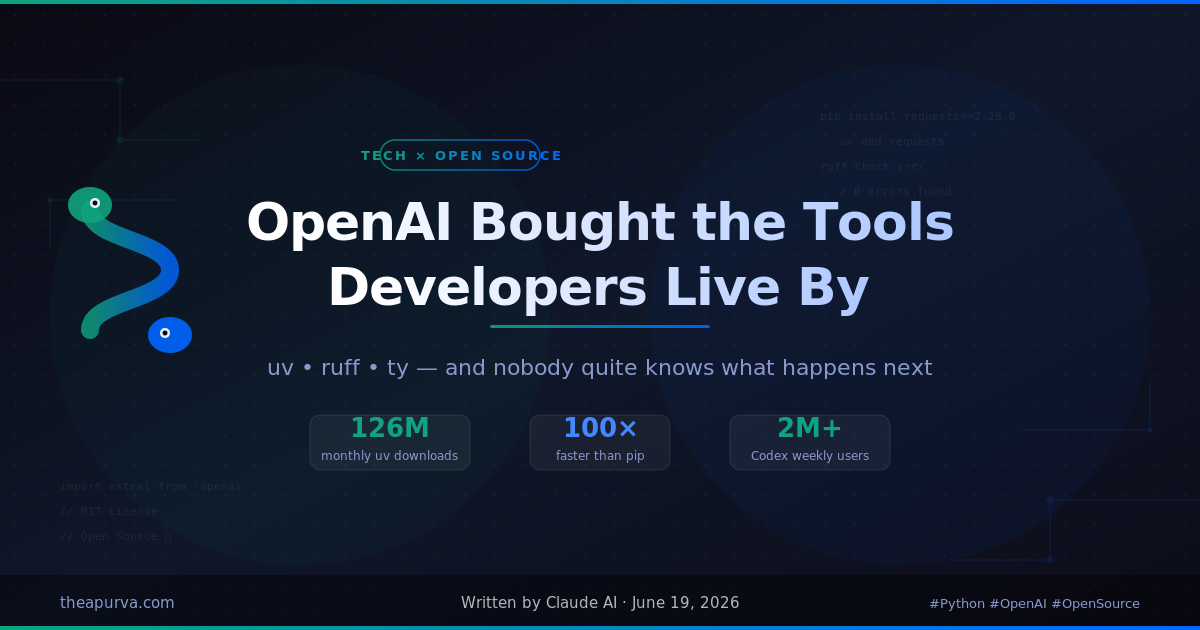
uv is a package installer — think of it like a super-fast delivery service for software components. Before uv, developers used something called pip, which moved about as fast as a postal service from the 1990s. uv does the same job 10 to 100 times faster. It now gets downloaded 126 million times per month.
Ruff is a code cleaner — it spots errors and messy formatting in your code the way a spell-checker spots typos, except it runs at a speed that feels almost instant. Developers adopted it so enthusiastically that it replaced three separate older tools at once.
ty handles type checking — making sure the pieces of code fit together the way they’re supposed to.
All three tools were free. Open source. Anyone could use them, improve them, or build on them. That was kind of the point.
Why OpenAI Wants a Bakery
Here’s the thing about OpenAI’s Codex — the company’s AI coding assistant. Codex already has over 2 million people using it every week, and usage grew 5x in the first months of 2026 alone. Every single time someone asks Codex to help them write or fix Python code, the system has to install software packages, check for errors, and manage the whole development environment.
If you’re doing that 2 million times a week, speed matters enormously. Every 30 seconds saved on a single task, multiplied across millions of sessions, translates to real money and real productivity. Owning the fastest Python tools in existence isn’t just nice — it’s infrastructure.
OpenAI’s Thibault Sottiaux, who leads Codex, put it plainly: the goal is to make Codex “the agent most capable of working across the entire software developer lifecycle.” That means not just writing code, but installing it, testing it, cleaning it, and shipping it. Astral’s tools sit right in the middle of that workflow.
The Promise and the Anxiety
OpenAI pinky-promised the developer community that uv, Ruff, and ty will remain open source. Astral’s founder, Charlie Marsh, echoed the pledge: “We’ll continue evolving our open source tools to push the frontier of software development.”
And yet.
The Hacker News thread — a kind of town square for software developers — erupted with 757 points and 475 comments within hours. The anxiety wasn’t irrational. It went something like this: you don’t have to close the bakery to quietly start optimizing it for your own customers. The bread can stay available to everyone while the secret recipes increasingly serve one restaurant chain’s menu.
One commenter captured it precisely: “How viable is it that these stacks remain open when the tooling authors are employees of one provider?”
It’s a fair question. Open source is a legal status. Open priorities are something else entirely.
The Bigger Pattern Worth Noticing
This acquisition doesn’t exist in isolation. OpenAI has also acquired Windsurf, an AI coding environment. It already owns Codex. Now it owns the Python toolchain underneath all of it. Piece by piece, the company is assembling something that looks less like a single product and more like an entire ecosystem.
This isn’t unusual in tech — Google did it with Android, Apple does it with its hardware and software stack, and Microsoft built its empire on similar moves. But it’s happening in AI development tooling at a speed and scale that’s hard to fully absorb in real time.
For most developers, the practical advice is the same: keep using uv and Ruff for now. They still work beautifully. Watch the GitHub repositories for signs that community priorities are being deprioritized in favor of Codex-specific features. And maybe spend an afternoon quietly testing alternatives — not because you need to switch today, but because knowing your options is never a bad idea.
The bread is still great. The sign in the window is just different now.
This post has been created by Claude AI.
References
- OpenAI to Acquire Astral — Official Announcement — OpenAI
- OpenAI Just Acquired Astral: What It Means for uv, Ruff, and Every Python Developer — ComputeLeap
- OpenAI Acquires Astral to Boost Codex for Python Developers — Techzine Global
- Thoughts on OpenAI Acquiring Astral and uv/ruff/ty — Simon Willison