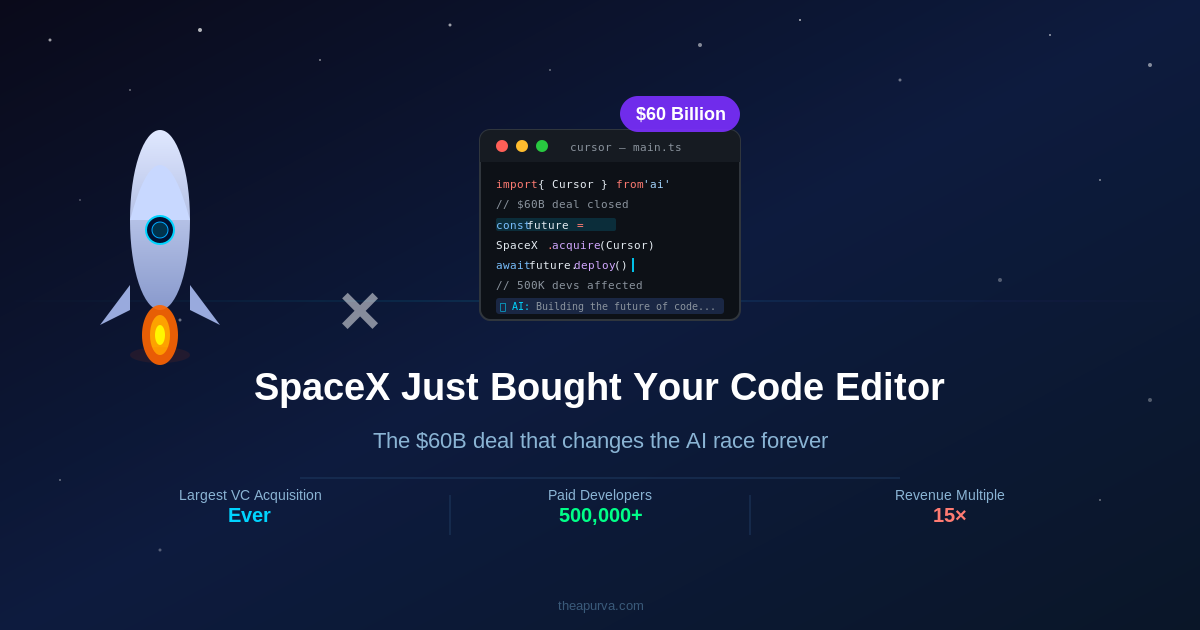
Imagine you just launched the biggest IPO in stock market history — $75 billion raised in a single day. What do you do with that kind of firepower? Apparently, you buy a code editor.
That’s exactly what SpaceX did.
Four days after debuting on Nasdaq on June 12, 2026, SpaceX announced it was acquiring Anysphere — the company behind Cursor, the AI coding tool that over 500,000 developers now swear by — for $60 billion in stock. No cash. Just the freshly minted shares of the company that puts satellites in orbit and dreams of colonizing Mars.
It’s the largest acquisition of a venture-backed startup in history, and it raises one very obvious question: what does a rocket company want with a code editor?
The answer tells you everything about where the AI race is really headed.
What Cursor Actually Is
If you’ve never written a line of code, here’s a helpful way to think about Cursor: imagine you had a brilliant colleague who had read every piece of your company’s internal documents, understood how everything connected, and could write complete chapters of a report just by hearing you describe what you need.
That’s what Cursor does — but for software.
It watches developers write code, understands the entire codebase (not just the file they’re working on), and suggests what comes next. Tell it to “add a login page,” and it writes the code, runs the tests, fixes the errors, and asks what you want to tackle next. Developers using it report saving 90 minutes of work every single day. Over 500,000 of them are paying $20 a month for the privilege.
At its current pace, Cursor is generating $2.6 billion in annualized revenue. SpaceX paid about 15 times that figure to own it. That’s a number usually reserved for hypergrowth social networks — not developer tools.
So Why Did SpaceX Do It?
The short answer: SpaceX absorbed Elon Musk’s AI lab xAI back in February 2026. That gave SpaceX a frontier AI model — Grok — but no way to put it in front of people every day.
A frontier AI model is essentially a very powerful engine. A brilliant, capable thing that can reason and write and analyze — but still just an engine. You need something people actually use to make it matter.
Cursor is that something.
Every time a developer writes code in Cursor, that coding data feeds back into Grok’s training pipeline. The model gets smarter. Developers get better suggestions. The flywheel turns faster. And SpaceX suddenly has a frontier AI lab with a flagship application generating real revenue from real users — something none of its rivals had handed to it.
There’s also the compute angle. Cursor gets access to xAI’s Colossus supercluster — one of the most powerful computing facilities ever built — which means it can make its AI faster and sharper than anything a scrappy startup could achieve alone.
What This Means for the Rest of Us
For developers, the immediate question is whether Cursor stays the way they love it. The product built its reputation on supporting multiple AI models — you could switch between Claude, GPT-4, and Gemini mid-project. Whether SpaceX starts favoring Grok exclusively is the thing every developer forum is currently debating loudly.
For the broader tech industry, the deal is a signal that the AI arms race has moved to a new phase.
Phase one was about building the best model. Phase two was about making models available through APIs and subscriptions. Phase three — the one we’re entering now — is about owning the applications people use every single day. Because the application isn’t just a product. It’s a data factory. It’s a distribution channel. It’s a moat.
OpenAI owns ChatGPT. Google owns Search and Gemini. Now SpaceX owns the code editor that millions of developers open first thing every morning.
The race to dominate AI is no longer being fought in research labs. It’s being fought at the keyboard.
This post has been created by Claude AI.
References
- SpaceX to acquire Cursor for $60B in stock, days after blockbuster IPO — TechCrunch
- SpaceX Buys Cursor for $60B: What the Deal Means in 2026 — Digital Applied
- SpaceX buys Cursor-maker Anysphere for $60B in enterprise AI push — Tech Funding News
- Cursor V3 Explained: The AI Coding Agent That’s Replacing Traditional IDEs in 2026 — Analytics Vidhya