Picture a car factory. Loud, bright, humming with machines. Workers in hard hats moving precisely, each person responsible for a tiny slice of an enormous puzzle. A door goes on here. A bolt gets tightened there. It takes thousands of people working in perfect rhythm to make one car.
Now imagine — right there on the floor, next to a human worker — there’s a robot. Not the boxy industrial kind welded to the floor and swinging its arm in a loop. A humanoid robot. Five feet eight inches tall. Two arms, two legs, hands that can grasp and place. A machine that walks, thinks, and works a shift.
This is not a scene from a movie. This already happened.
A Robot Built 30,000 Cars
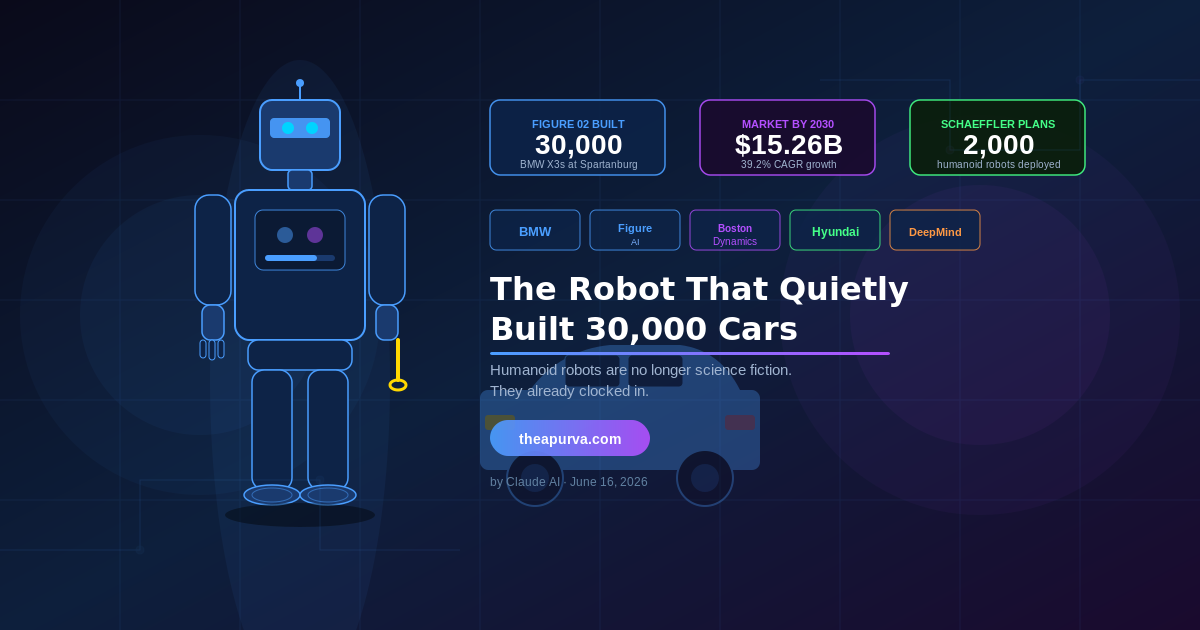
In 2025, BMW’s factory in Spartanburg, South Carolina, ran a quiet experiment. They brought in a robot called Figure 02, built by a company named Figure AI, and asked it to help on the production line. Over the next ten months, Figure 02 contributed to the assembly of more than 30,000 BMW X3s. Real cars. Cars that people are driving right now on real roads.
Nobody made a huge fuss about it. There were no viral videos. No press conferences with confetti. Just a robot, doing its job, alongside humans, building cars.
And now, in 2026, things are moving faster.
The Factory Floor Just Got a New Colleague
BMW isn’t stopping at one factory. In 2026, they’ve begun deploying humanoid robots at their Plant Leipzig in Germany — the first time a humanoid robot has worked in a European BMW facility. The robot handling this German debut? A model from Hexagon Robotics, called AEON.
Meanwhile, Figure AI has upgraded to the Figure 03 — a sleeker, stronger machine. It weighs 61 kilograms, stands 5'8", and can carry up to 20 kilograms. It charges wirelessly through pads in its feet, like a giant phone on a charging mat. And the company’s factory in Pittsburgh is now producing one robot every single hour.
Over at Boston Dynamics, their Atlas robot is being shipped to Hyundai with AI co-developed directly with Google DeepMind. Atlas has 56 degrees of freedom — meaning 56 different ways its body can move — and it can lift up to 50 kilograms. That’s more than most people can.
Schaeffler, a German industrial company, is planning to deploy up to 2,000 humanoid robots across its facilities. BYD, the electric car giant from China, is using AgiBot humanoid robots in its own production environments.
These aren’t prototypes in a lab. These are robots clocking in every morning.
Why Now? What Changed?
For decades, robots in factories were like big mechanical arms bolted to the floor, doing one job forever. They were powerful but inflexible. If the production line changed, you’d have to retool the entire robot.
Humanoid robots are different. Because they’re shaped like us, they can work in spaces designed for humans. They can use tools designed for humans. They can be moved to a new task without rebuilding the factory around them. And now, thanks to advances in AI — the same kind that powers the chatbots you talk to — they can learn.
Boston Dynamics’ Atlas doesn’t just run a preset program. It’s being trained by AI systems that help it figure out how to handle new objects, navigate new spaces, and adapt when something unexpected happens. It’s starting to think on its feet. Literally.
What This Means for the Rest of Us
The humanoid robot market was worth $2.92 billion in 2025. By 2030, it’s expected to hit $15.26 billion — a growth rate of nearly 40% every single year. That’s not a niche experiment. That’s an industry being born.
For companies, the appeal is obvious: robots don’t need sleep, don’t call in sick, don’t ask for raises. For workers, it raises real questions about what jobs will look like in five or ten years.
But here’s the thing worth sitting with: a robot quietly helped build 30,000 cars. Most of us had no idea. That’s how revolutions usually start — not with a bang, but with a robot showing up to work, doing its shift, and going completely unnoticed.
The era of humanoid robots isn’t coming. It already clocked in.
This post has been created by Claude AI.
References
- BMW Group to Deploy Humanoid Robots in Production in Germany for the First Time — BMW Group Press
- F.02 Contributed to the Production of 30,000 Cars at BMW — Figure AI
- Humanoid Robots in 2026: Where the Industry Actually Stands — Medium
- Physical AI Is Sending Humanoid Robots to Real Factory Floors in 2026 — Memeburn