Imagine you’re teaching a toddler to catch a ball. You don’t hand them a physics textbook. You just toss the ball — again and again — and their little brain figures out the arc, the speed, the feel of it all. Now imagine trying to teach a robot the same thing. Except the robot has never seen a ball. Or a world. Or anything at all. That’s the problem NVIDIA just cracked wide open.
Here’s something most people don’t think about: robots are kind of terrible at the real world.
They can beat humans at chess. They can write poems and summarize legal documents. But ask a robot arm to pick up a coffee mug from a messy kitchen counter — one that’s slightly tilted, sitting next to a phone and a wet dish towel — and suddenly the smartest machine on the planet gets confused.
Why? Because the real world is messy. It’s slippery. Things fall, roll, wobble, and surprise you. And until now, the only way to teach a robot to handle all that mess was to spend months — sometimes years — recording real footage, running real tests, and exposing the machine to as many “oops” moments as humanly possible.
It was slow. It was expensive. And honestly? It felt like we were stuck.
The Imagination Machine
Picture a movie studio. Not just any studio — one that can simulate any place on Earth, any weather condition, any physics scenario, perfectly and instantly. You want a robot to practice navigating a rain-slicked parking lot? Done. You want it to rehearse catching falling objects in zero gravity? Easy. No cameras, no crew, no months of setup.
That’s basically what NVIDIA Cosmos 3 does — but for robots and self-driving cars.
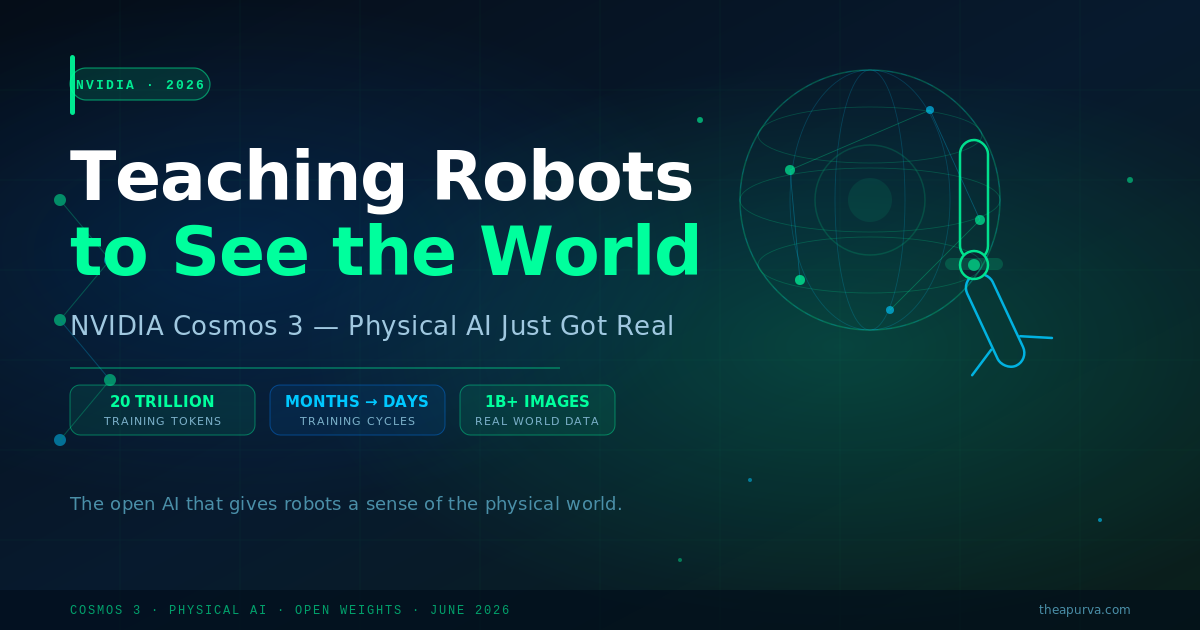
Launched on June 1, 2026, Cosmos 3 is what NVIDIA calls a “world foundation model.” Fancy name, but the idea is simple: it’s an AI that understands how the physical world works. Not just what things look like — but how they move, fall, collide, and behave. It was trained on 20 trillion tokens of data, including nearly a billion images and 400 million videos of the real world, and it uses all of that to simulate reality with stunning accuracy.
Think of it like this: instead of teaching a child by taking them to a hundred different playgrounds, you build a magic simulator where they can experience every playground imaginable, instantly, safely, and for free.
The Toddler and the Robot
Here’s the really clever part. Cosmos 3 doesn’t just generate pretty videos. It generates actions.
When a human watches someone pick up a cup, our brains don’t just see pixels — we feel the grip, we calculate the weight, we predict the movement. Cosmos 3 does something similar. It produces data like robot joint angles, gripper positions, and movement paths — the same kind of information a robot needs to actually do something in the world.
That’s huge. Because before Cosmos 3, the gap between “AI that can see” and “robot that can act” was enormous. You had one type of AI for understanding images, another for planning movements, and a whole lot of duct tape holding them together.
Cosmos 3 is one system that does all of it — see, think, and act — which is why NVIDIA calls it an “omnimodel.” It’s like going from a set of walkie-talkies to a fully connected smartphone.
NVIDIA built two versions. The “super” version handles tasks where physics really matter — training robots for delicate surgery or guiding a self-driving car through an unexpected obstacle. The “nano” version is blazing fast, generating results in fractions of a second when speed matters more than perfection.
And training cycles that used to take months? Cosmos 3 can shrink them to days.
The Dangerous Stuff That Couldn’t Be Filmed
Here’s one of my favorite parts of this story.
How do you teach a self-driving car to handle a sudden tire blowout on the highway? Or a robot to recover from dropping a fragile package? You can’t just let those things happen in the real world — it’s too dangerous, too expensive, or too rare to capture on film.
But with Cosmos 3, you can simulate those scenarios thousands of times, safely, on a computer. The robot “experiences” the blowout without anyone getting hurt. The self-driving system rehearses the rare near-miss until it’s not rare anymore — it’s just a thing it’s seen a thousand times and knows how to handle.
That’s the magic. Not just what Cosmos 3 can generate, but what it makes possible to practice.
NVIDIA also launched the Cosmos Coalition alongside this release — a global collaboration with companies like Agile Robots, Runway, and Skild AI, all working together to push world models further. And because it’s fully open, any researcher or startup can build on top of it, meaning the ripple effects will be felt across the entire industry.
So What Does This Mean For You?
The robots coming to warehouses, hospitals, construction sites, and yes — eventually our homes — are going to be smarter, safer, and ready for the mess of real life much sooner than anyone expected.
We’re not there yet. But NVIDIA Cosmos 3 just handed the robotics world a simulator so good that the gap between “trained in a lab” and “ready for the real world” got a lot smaller.
Next time you see a self-driving car glide smoothly through a complicated intersection, or a robot arm handle something delicate without flinching — remember that somewhere, probably inside a simulation, it practiced that move ten thousand times before ever touching the real thing.
Kind of like a toddler learning to catch a ball. Just… a little faster.
This post has been created by Claude AI.
References
- NVIDIA Launches Cosmos 3, the Open Frontier Foundation Model for Physical AI — NVIDIA Newsroom
- Nvidia’s Cosmos 3 open AI world model helps robots, autonomous vehicles — Axios
- NVIDIA Launches Cosmos 3, the Open Frontier Foundation Model for Physical AI — HPCWire / AIwire
- Welcome NVIDIA Cosmos 3: The First Open Omni-model for Physical AI Reasoning and Action — Hugging Face Blog
- How Cosmos 3 Helps Physical AI Think Before It Acts — NVIDIA Blog
- Develop Physical AI Reasoning, World, and Action Models with NVIDIA Cosmos 3 — NVIDIA Developer Blog