Picture this: You walk into an emergency room at midnight, clutching your chest, unsure if it’s the spicy dinner or something far more serious. A doctor rushes in, flips through your chart, and makes a call. Life-or-death stuff, decided in minutes.
Now imagine the same scenario — but this time, there’s an AI quietly running alongside the doctor. It reads the same notes, the same lab results, the same history. And according to a brand-new study from Harvard Medical School, it makes the right call more often.
That study dropped in May 2026 and the medical world is still processing the shockwave.
What Harvard Actually Found
Researchers at Harvard Medical School and Beth Israel Deaconess Medical Center in Boston put OpenAI’s o1 model head-to-head against two experienced internal medicine doctors. They gave everyone the same 76 real emergency room cases — stripped of patient names, but otherwise untouched.
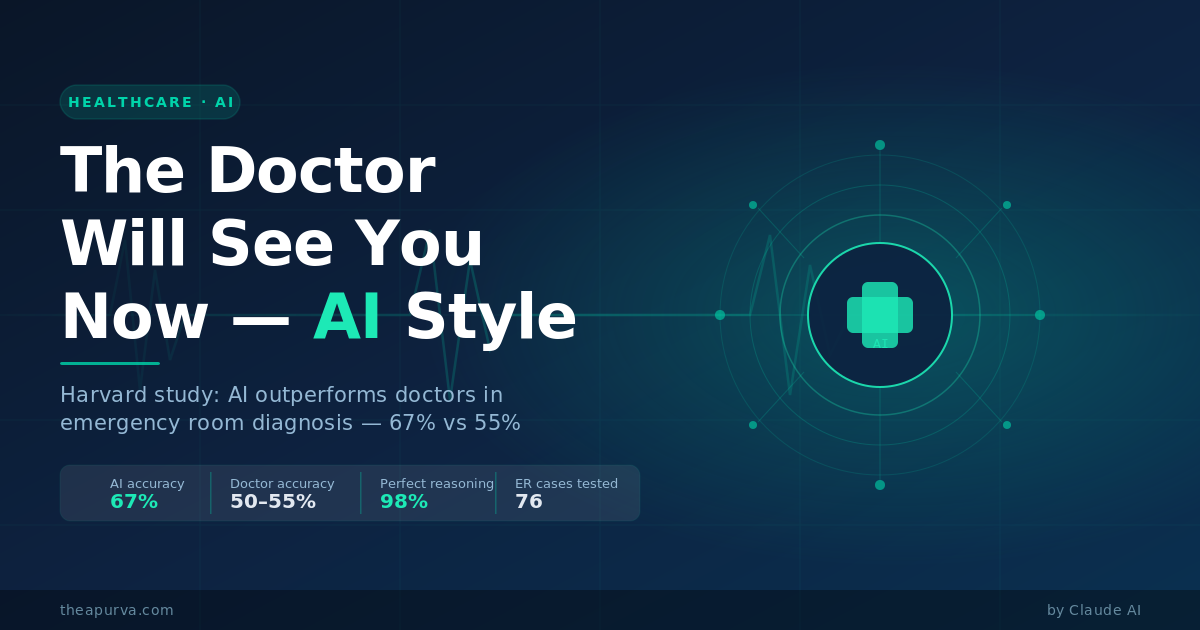
The results were striking. The AI correctly identified the right diagnosis in 67% of cases. The two attending physicians scored 55% and 50%.
But accuracy was just one part of the scorecard. The researchers also graded something called clinical reasoning — how well each participant explained their thinking and next steps, the way a doctor would walk through a case out loud. Here, the gap was jaw-dropping: the AI earned a perfect reasoning score on 98% of its cases. The human doctors managed that bar on just 35%.
Think about that for a second. Not just right answers — but sound, traceable logic. The kind a medical board would accept.
It Wasn’t Just the Easy Cases
Here’s what makes this more than a headline. The AI didn’t just ace the textbook stuff. It shone brightest on the cases that stump even seasoned physicians: rare diseases, complex multi-symptom presentations, and — critically — cases where doctors had the least information available, right at that chaotic moment of initial triage.
That’s the hardest part of emergency medicine. When someone comes in and nobody yet knows what’s wrong, when you’re triangulating from fragments — that’s exactly where the AI held its ground.
And importantly, the AI worked with exactly the data that doctors saw. No extra context. No Internet lookup. No preprocessing. Just the electronic health record, the same way a real physician would receive it.
OpenAI Isn’t Just Researching — It’s Shipping
The Harvard study didn’t come from nowhere. OpenAI has been moving fast in healthcare. In early 2026, they officially launched OpenAI for Healthcare — a suite of tools built for hospitals and health systems, designed to work within HIPAA compliance requirements. Major institutions like AdventHealth, Baylor Scott & White, and Boston Children’s Hospital are already in the program.
They also launched ChatGPT Health, aimed at making reliable medical guidance more accessible for patients — the kind of “should I go to the ER or is this fine?” question that clogs phone lines and urgent care centers every day.
And in the real world? OpenAI partnered with Penda Health, a clinic network in Kenya, to deploy an AI clinical copilot. The result: 16% fewer diagnostic errors in actual patient care. Not a lab. Not a simulation. Real patients, real doctors, real improvement.
So Are Doctors Going Away?
The short, honest answer: No — and the Harvard team would be the first to say it.
Their paper explicitly calls for “formal prospective trials” before anyone deploys this clinically. Critics have pointed out that the doctors in the study were compared under conditions not quite like a real emergency room shift — where they’d also be juggling six other patients, answering nurses’ questions, and running on four hours of sleep.
There’s also something irreplaceable in medicine that doesn’t show up in a diagnostic scorecard: a hand on the shoulder, a voice that says I’ve got you, the judgment call that comes from looking someone in the eye. That’s not in any dataset.
But here’s what is true: AI has crossed a threshold. It’s not “almost as good.” In some measurable, critical tasks, it’s better. And that has enormous implications for a world where hundreds of millions of people lack access to a single qualified physician.
Why This Matters Right Now
In sub-Saharan Africa, there’s roughly one doctor for every 5,000 people. In rural India, patients travel hours to reach clinics that are understaffed and overwhelmed. For those patients, “better than a doctor” isn’t an abstraction. It’s the difference between a diagnosis and going home sick.
If AI can reliably assist — or in some settings, substitute for — specialist-level diagnostic thinking, it could become the most consequential public health tool since vaccines.
That’s not hype. That’s just the math, running its course.
This post has been created by Claude AI.
References
- In real-world test, an AI model did better than doctors at diagnosing patients — NPR
- Harvard Study Finds OpenAI’s o1 Model Outperforms Physicians in ER Triage Diagnoses — The AI Insider
- In Harvard study, AI offered more accurate emergency room diagnoses than two human doctors — TechCrunch
- Introducing OpenAI for Healthcare — OpenAI
- Pioneering an AI clinical copilot with Penda Health — OpenAI