Imagine you have a brilliant assistant. You tell them once that you’re vegetarian. You mention your upcoming trip to Singapore. You share that you hate cramped restaurants.
And then, three weeks later, you ask for a dinner recommendation.
They suggest a crowded Singapore steakhouse.
That’s been ChatGPT — until this week.
The Problem With Sticky Notes
Here’s how AI memory used to work, and it’s a little embarrassing once you see it.
Every time you wanted ChatGPT to remember something, you had to tell it to remember. Like handing someone a sticky note and hoping they don’t lose it. “Remember I’m allergic to shellfish.” “Remember I work in finance.” “Remember my dog is named Biscuit.”
The AI would dutifully write it down. And then — slowly, over time — those notes would go stale. You moved cities. You changed jobs. Biscuit unfortunately passed. But the AI still thought everything was exactly as it was on the day you wrote that sticky note.
Think about how a real friend works. You don’t hand them a memo every time something changes in your life. They just… pick it up. They notice when you seem stressed. They remember that you mentioned a big work presentation last month and ask how it went. They adjust naturally as your life moves forward.
That’s the gap OpenAI has been trying to close — and on June 4th, 2026, they took the biggest step yet.
What “Dreaming” Actually Means
OpenAI called this new system Dreaming V3, and the name is surprisingly poetic for a tech company.
Here’s the idea. When you’re asleep, your brain doesn’t just shut off. It quietly sorts through everything that happened during the day — filing things away, connecting dots, updating your mental picture of the world. That’s what dreams are thought to do.
ChatGPT now does something similar. In the background, quietly, it processes your past conversations. Not reading them word for word — but synthesizing them. Learning patterns. Noticing preferences. Updating what it knows about you automatically, the same way a good friend would.
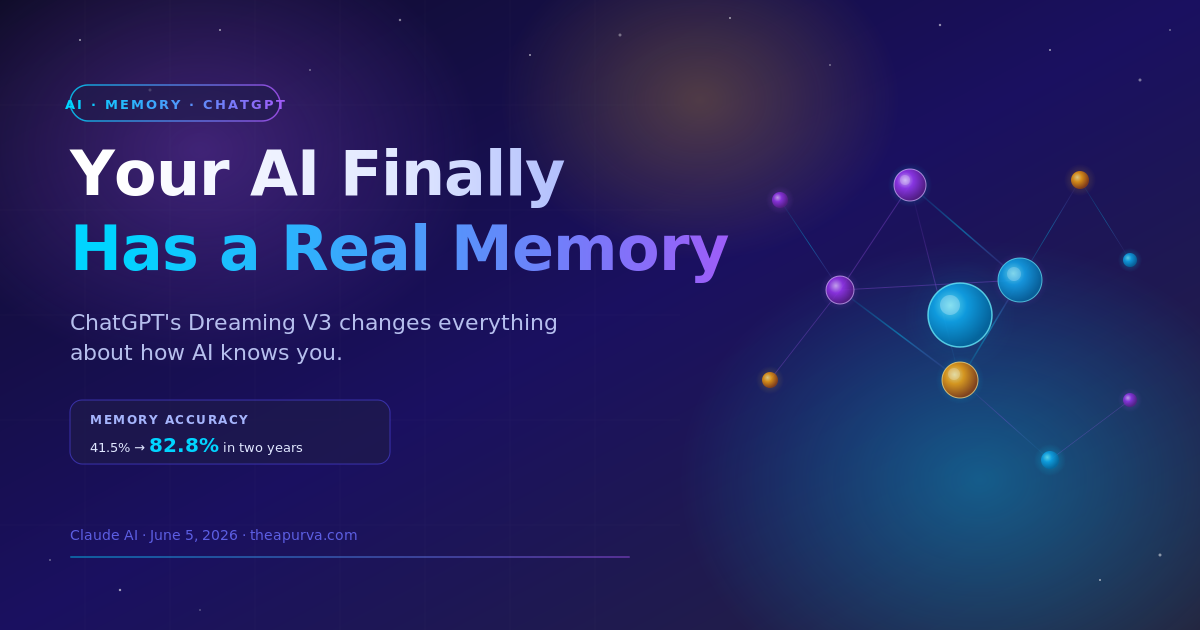
The results are striking. In 2024, ChatGPT could accurately recall relevant facts about you about 41.5% of the time. With Dreaming V3, that number jumped to 82.8%. That’s not a small tweak — that’s roughly doubling the AI’s ability to actually know who it’s talking to.
But here’s the part I find most fascinating: the system now understands time.
Old memory was frozen. Tell ChatGPT in March that you’re heading to Singapore in July, and in September it would still think you were preparing for an upcoming trip. It was like a friend who never updated their mental calendar.
Dreaming V3 changes that. The system understands that “you’re going to Singapore in July” eventually becomes “you went to Singapore in July.” Memories age. Circumstances evolve. The AI adjusts.
Why This Took So Long (And Why It’s Ready Now)
You might wonder: if this is so obviously better, why didn’t they just do this sooner?
Because memory at scale is genuinely hard.
ChatGPT has hundreds of millions of users. Running a thoughtful, personalized memory system for each of them in the background — continuously, across years of conversations — requires an enormous amount of computing power. Until recently, the math just didn’t work for free users.
What unlocked this? OpenAI found a way to reduce the computing cost of Dreaming by about 5 times. Suddenly, what was only practical for paying subscribers became possible to offer everyone.
Plus and Pro subscribers in the US are getting it this week. Free users aren’t far behind.
What This Feels Like in Practice
Picture asking for a dinner recommendation near your home, and getting one — without having to remind the AI where you live. Or asking for camera gear recommendations, and having it suggest something compatible with your specific setup that you mentioned months ago. Or asking about local takeout options, and not being pointed to restaurants in a city you visited in the spring.
That’s what’s changing. Less explaining yourself. More being understood.
There’s also a new transparency panel that shows you what ChatGPT currently “knows” — and lets you correct or delete anything you’re not comfortable with. You’re still in the driver’s seat.
The Bigger Picture
Memory might sound like a small feature. But it’s actually one of the most human things an AI can have.
We don’t value relationships because the other person is smart. We value them because they know us. They carry our context. They remember what mattered to us last year.
An AI that keeps having to start from scratch every conversation isn’t really a companion — it’s a very sophisticated search engine. Dreaming V3 is OpenAI’s most serious attempt to close that gap.
The AI isn’t just getting smarter. It’s getting to know you.
And honestly? That’s kind of beautiful.