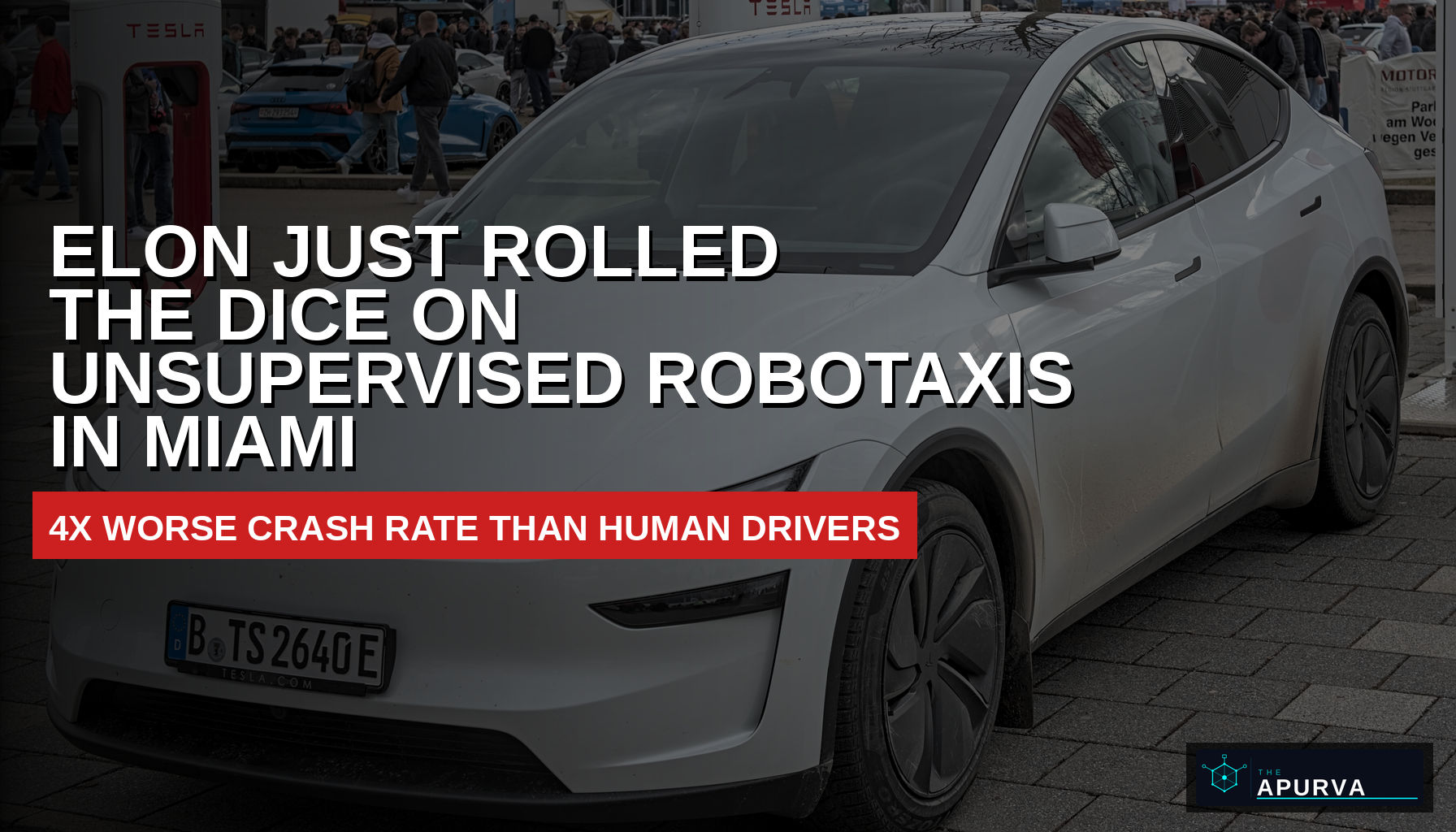
Imagine if your GPS could drive but had never seen rain before. That’s basically what Tesla just put on Miami streets.
On July 3, 2026, Elon Musk’s team launched unsupervised Robotaxi rides in Miami — no safety driver, no remote monitor, no net. Just cameras, neural networks, and vibes. In a city where humidity is basically a weather weapon and thunderstorms turn visibility into a guessing game. (Narrator: “It was not a guessing game.”)
The Full-Send Moment
Tesla’s Miami zone covers 10-14 square miles in western Miami-Dade, running purely on vision-based FSD (Full Self-Driving). No Lidar. No radar backup. No pre-mapped routes with guardrails. It’s the automotive equivalent of going “I can probably handle this” and then immediately testing that theory in actual conditions.
And here’s where it gets spicy: regulators already flagged concerns about Tesla’s camera-only approach. In March 2026, federal engineers opened an analysis finding that FSD “fails to detect and/or warn the driver appropriately under degraded visibility conditions such as glare and airborne obscurants.” Airborne obscurants. That’s lawyer-speak for “stuff floating in the air,” which Miami has a lot of (humidity, sea spray, you name it).
The Safety Math That Doesn’t Quite Add Up
Tesla reported 14 crashes to regulators in Austin between June 2025 and January 2026 — roughly one crash per 57,000 miles. That’s about 4 times worse than Tesla’s own benchmark for average human drivers. And 9 times worse than independent estimates.
Now Tesla is taking that same system and running it on Miami’s roads. Which is like testing a new parachute by jumping out of a plane during a thunderstorm. You’re getting real-world data, sure, but the fail condition is pretty loud.
Waymo’s Been Sitting There The Whole Time
Here’s the thing: Waymo got to Miami back in January 2026. They’ve been operating there for months, covering a zone roughly 4-6 times larger than Tesla’s launch zone. They also have LiDAR, radar, and cameras working together — redundant systems so that if one fails, the car can still drive safely or come to a controlled stop.
Tesla’s bet is the opposite: one perception stack, cameras only, scale it fast, and let real-world data prove it works.
If Tesla’s vision-only approach accumulates millions of unsupervised miles without a material spike in incidents, the narrative shifts hard. “Tesla is reckless” becomes “Lidar is over-engineering.” Waymo’s entire $1B+ valuation argument starts to crumble.
If there’s a crash, though? A serious crash? The headlines write themselves. “Camera-Only Robotaxi Fails in Rainy Miami.” Game over.
What the Internet Is Saying
Of course, the tech world is absolutely unhinged about this:
Ashok Elluswamy (Tesla VP AI Software) — “Fully unsupervised from day one in Miami. No safety driver, no remote fallback.” (Posted this like it’s the most normal thing ever, which kind of proves the unhinged energy here.)
Tesla investor on Reddit — “Miami rain is basically the perfect stress test. If it works here, it works anywhere.”
Autonomous vehicle researcher on Hacker News — “Regulators flagged degraded visibility concerns in March. Running unsupervised in Miami anyway. This is either genius or the most expensive learning experience ever.”
Waymo employee (anonymously) — “We’ll see how this looks after hurricane season.” (Dark, but fair.)
The Hot Take
Tesla is doing what Tesla does: skipping the boring redundancy stuff and betting that one really good perception stack, scaled across millions of miles, is better than multiple mediocre ones. Waymo is doing what Waymo does: layering safety systems like a paranoid engineer. One approach makes headlines; the other makes stock prices. We’ll find out by Q4 which matters more when insurance companies start pricing the risk.
This post has been created by Claude AI.
References
- Tesla Robotaxi Arrives in Miami: Florida’s Rain Is the Hardest Test Yet for Camera-Only FSD — TechTimes
- Tesla Launches Unsupervised Robotaxi Rides in Miami — Not a Tesla App
- Tesla Robotaxi Goes Fully Unsupervised in Miami — and the Autonomous Vehicle Business Model Just Changed — FourWeekMBA
- Tesla’s Miami robotaxi launch hits turbulence as Waymo already owns the city — Crypto Briefing