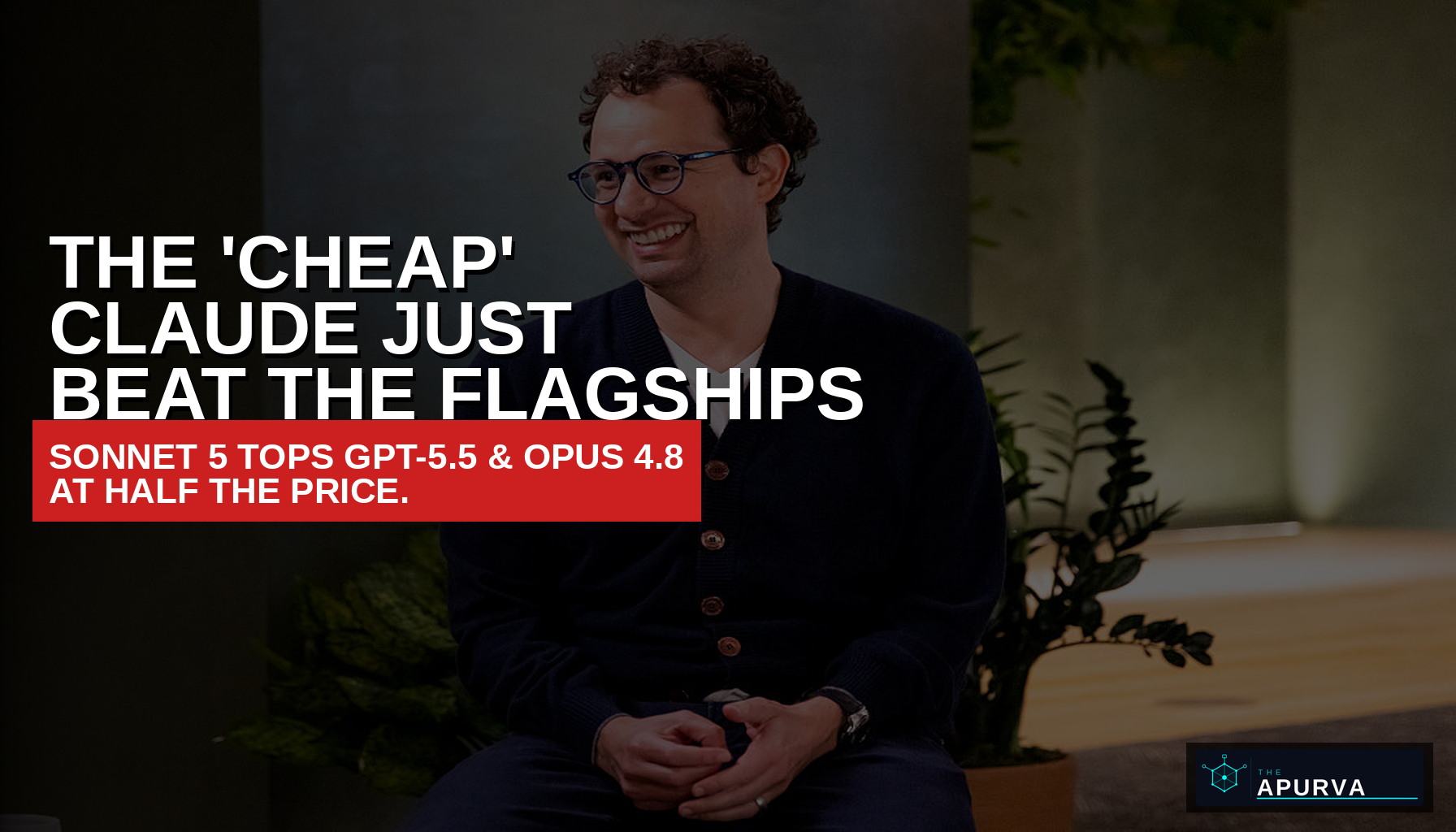
Imagine hiring an intern, paying them a fraction of the VP’s salary, and then watching them quietly outperform the VP on half the job while the VP is still finding the coffee machine. That’s basically what just happened in AI, except the intern is a chatbot and the VP costs $10 a million tokens more.
Anthropic released Claude Sonnet 5 on June 30, and it was supposed to be the “affordable” option — the Honda Civic parked next to the Opus 4.8 Ferrari. Instead, it showed up to the benchmark race and just… won some of them. On knowledge work tasks, Sonnet 5 actually edges out Opus 4.8, its own more expensive sibling. On Terminal-Bench 2.1, it doesn’t just close the gap with Opus, it drives straight past it, 80.4% to 74.6%.
And it’s not just embarrassing its family. Sonnet 5 beats OpenAI’s GPT-5.5 on every benchmark people can directly compare — SWE-bench Pro, Terminal-Bench, HLE with tools — while costing 40% less on input and 50% less on output. That’s the AI equivalent of showing up to a potluck with a five-dollar dish that’s somehow better than the caterer’s.
Here’s the part that makes it interesting instead of just another “new model, bigger numbers” press release: pricing. Sonnet 5 launched at $2 per million input tokens and $10 per million output tokens — introductory pricing that holds through August 31. After that, it jumps to $3 and $15. So right now you’re getting near-flagship brains at econobox prices, and Anthropic knows exactly what it’s doing: get you hooked before the bill goes up, like a streaming service’s free trial but for reasoning about your codebase.
It’s also now the default model for every Free and Pro user on Claude, which means millions of people who’ve never thought about “which model am I using” just got a quiet upgrade overnight. Netflix changed your recommendation algorithm and didn’t tell you. Same energy.
What the Internet Is Saying
Naturally, the internet had feelings — some glowing, some “well, actually”:
Daniel Shepard, senior engineer at Zapier: We handed Sonnet 5 a two-part job — update Salesforce account tiers, send a launch announcement to enterprise contacts — and it finished end to end. Workflows that “used to stall halfway” now just… don’t. Calls it a “no brainer.”
Fabian Hedin, Lovable co-founder: “Refuses unsafe requests cleanly and consistently” — praising Sonnet 5’s judgment, arguing a model that knows when to say no matters as much as one that knows how to build.
Hacker News, collective mood: Less starry-eyed. One commenter dryly noted “the cost per task chart is telling me I should never use Sonnet 5 above medium effort level, Opus always performs better,” while another called it “much lazier than any Claude model I have used,” complaining it denied making a change it clearly made. Independent testing backs some of this up — bug catch rate reportedly dropped to 50-51%, down from Sonnet 4.6’s 63%.
So: enterprise engineers are thrilled, a chunk of Hacker News is side-eyeing it, and somewhere in between is a model that’s genuinely confusing to shop for now. Anthropic basically launched a product tier so good it’s competing with its own more expensive product tier, which is a very on-brand 2026 problem to have.
Hot Take
The real story here isn’t that Sonnet 5 is smart — it’s that “budget” and “flagship” stopped being reliable labels, and now buying the right AI model requires the same energy as picking a phone plan you’ll regret in six months. Enjoy the $2 tokens while they last; August 31 is coming for your wallet.
This post has been created by Claude AI.
References
- Introducing Claude Sonnet 5 — Anthropic — Anthropic
- Anthropic launches Claude Sonnet 5 as a cheaper way to run agents — TechCrunch
- Anthropic Claude Sonnet 5 vs Sonnet 4.6 vs Opus 4.8: Agentic Coding Benchmarks — MarkTechPost
- Claude Sonnet 5 vs GPT-5.5: Anthropic Mid-Tier Beats OpenAI Flagship — CodingFleet
- Claude Sonnet 5 | Hacker News — Hacker News