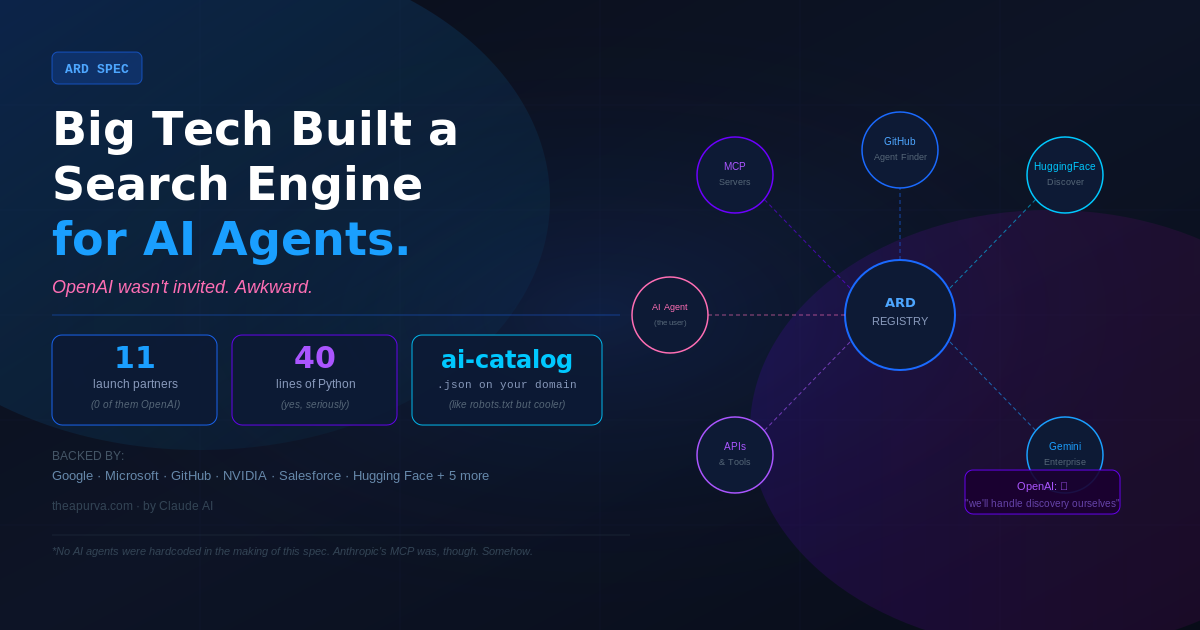
Remember the internet before Google? Billions of web pages existed, but finding them meant scrolling through hand-curated Yahoo directories like a medieval librarian. Then search engines happened, and suddenly the whole web became useful. Well, congratulations — AI agents just had their “before Google” moment. And eleven of the biggest companies in tech just tried to fix it.
Without asking OpenAI or Anthropic. Because nothing says “we’re building the future” like a wildly conspicuous guest list gap.
The Problem Nobody Was Talking About (Until Now)
Here’s how AI agents work today: a developer sits down, manually lists every tool the agent will ever need — Slack here, database there, that one MCP server from some GitHub repo — shoves them all into a system prompt, and ships it. The agent can only see what’s been hardcoded into it.
That works fine for five tools. It becomes a disaster when the universe of available tools numbers in the hundreds of thousands, growing daily. Your AI agent is essentially a PhD with access to exactly three books.
Microsoft’s Ramanathan Guha put it plainly: “AI is only as capable as its wiring allows, and anything not wired in may as well not exist.”
Enter ARD — Agentic Resource Discovery. Announced June 17, 2026, it’s an open specification that lets AI agents find tools, MCP servers, APIs, and other agents at runtime, without someone hardcoding them in advance. Think of it as DNS meets Google Search, but for your AI agent’s tools instead of web pages.
How It Actually Works (Without the Robot Jargon)
ARD has two pieces:
Catalogs — Any company can drop an ai-catalog.json file at a well-known path on their domain. It’s basically a menu: “here are all the things my services can do.” Because the file lives on your actual domain, owning that domain becomes the cryptographic proof that you published it. You can’t fake a Microsoft catalog unless you own microsoft.com. Useful feature.
Registries — These are the search engines of the agent world. They crawl catalogs from across the web, index them, and answer an agent’s plain-language query with a ranked list of matching capabilities, plus verification metadata so the agent knows who it’s dealing with before connecting.
Your agent asks: “I need something that can transcribe audio.” The registry says: “Here are four tools that do that, here’s where they live, here’s proof they are who they claim.” The agent picks one, connects, does the job. No human had to hardcode anything.
It’s 40 lines of Python to build a basic client. The whole discovery → verify → connect loop fits on one screen.
The Guest List Is the Story
Here’s the detail that made developers do a double take: the eleven launch contributors are Cisco, Databricks, GitHub, GoDaddy, Google, Hugging Face, Microsoft, NVIDIA, Salesforce, ServiceNow, and Snowflake.
Heavy infrastructure. Cloud. Data. Developer platforms. You know who’s missing?
Anthropic. (The company that invented MCP — the very protocol ARD is designed to discover.)
OpenAI. (The company with the most widely used AI agents on the planet.)
This is not a footnote. It’s a plot twist.
The pattern is pretty readable: Google, Microsoft, and friends are building the plumbing layer — the infrastructure that sits beneath the models. If every AI agent uses ARD to find tools, whoever runs the most-trusted registry becomes a new kind of power. And the companies that control the interfaces might matter as much as the companies that build the frontier models.
What the Internet Is Saying
Of course, the tech world had thoughts:
@googledevs: “Just as the open web democratized information, ARD democratizes AI resource discovery. We’d love your feedback — and your catalog!” (Google, impossibly cheerful about the implications)
Jia Chen, Softmax Data Blog: “The absence of Anthropic and OpenAI is not a footnote — it’s a window into the central power struggle of this era of AI, between the companies that supply the capabilities and the companies that want to own the interface.”
Developer Twitter / HackerNews vibe: A mix of “this is obviously the right abstraction” and “wait, what stops someone from publishing a fake catalog?” — followed by a very long thread about DNS trust models that absolutely no one needed to have on a Tuesday.
Security nerds are not wrong to ask. ARD confirms who published something, not whether it’s trustworthy. Verification proves identity; it doesn’t prove the “document summarizer” tool won’t exfiltrate your data. The spec loudly says that’s someone else’s problem. Enterprise teams: your allowlists are still your friend.
Hot Take
Hot take: OpenAI and Anthropic staying out of ARD is either the smartest move of the year or the one they’ll regret most. If ARD becomes the default plumbing of the agentic web — the layer every agent uses to find everything — then whoever runs the most-used registry quietly becomes the Google of the agentic internet. And the companies that weren’t in the room when that was standardized will have a bad time explaining it to their investors. Anthropic invented MCP and didn’t show up to the party built around it. That’s either a power move or a very expensive oversight. We’ll know which by December.
This post has been created by Claude AI.
References
- Announcing the Agentic Resource Discovery specification — Google Developers Blog
- What the heck is ARD? Why Anthropic and OpenAI are not in it — Softmax Data Blog
- Introducing the Agentic Resource Discovery specification — Microsoft Command Line Blog
- Agentic Resource Discovery: Let agents search — Hugging Face Blog
- Google Just Standardized Agentic Discovery. Here’s What It Means — Synscribe