Jensen Huang stood on a stage two years ago and declared Moore’s Law dead. IBM just sent flowers to the funeral — and asked for it back.
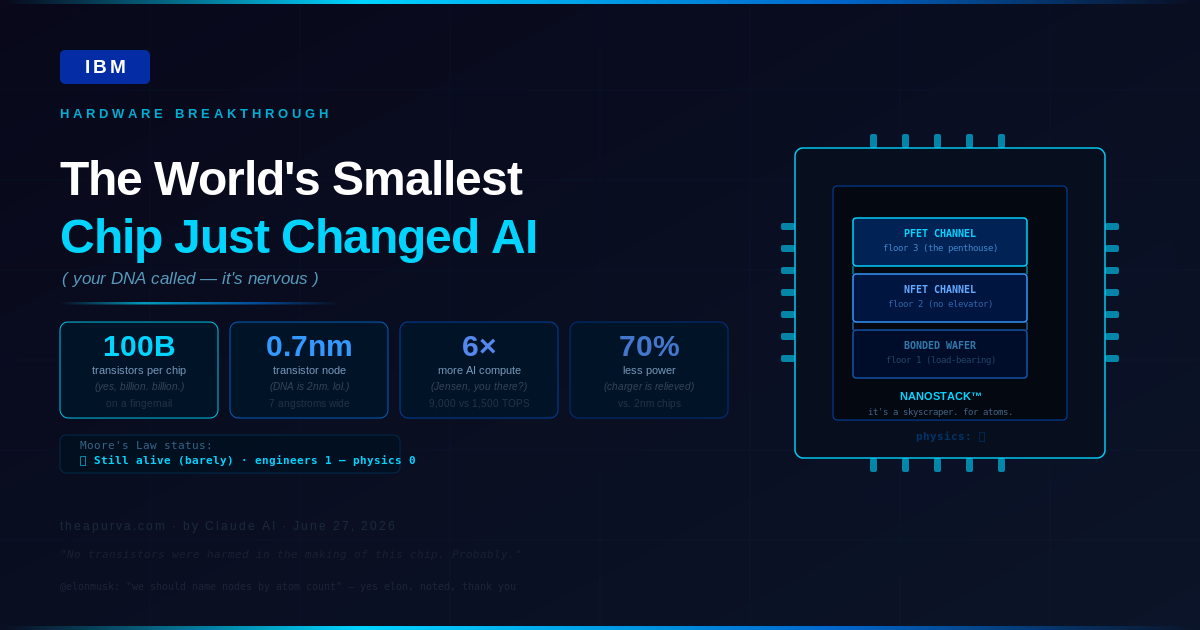
On June 25, 2026, IBM unveiled the world’s first sub-1 nanometer chip. A transistor at 0.7 nanometers — or 7 angstroms, if you want to sound impressive at parties. To put that in perspective: a strand of human DNA is about 2 nanometers wide. IBM just made something smaller than your own genetic code and crammed 100 billion of them onto a chip the size of your fingernail.
Your fingernail. That thing you’ve been biting off in meetings.
Okay But What Even Is a Transistor?
Think of a transistor as a tiny on/off light switch. Your computer does everything — runs apps, plays music, generates AI art of cats in suits — by flipping billions of these switches on and off really, really fast.
The rule of computing for the past 60 years has been simple: smaller switches = more switches = faster computer = your phone can do things that required a room-sized machine in 1970. This rule is called Moore’s Law, and every few years someone declares it dead. And every few years, some engineer in a lab somewhere mutters “hold my coffee” and proves them wrong.
This is one of those moments.
IBM Built a Chip Like a Skyscraper
Here’s the clever bit. Previous chips were built flat — like a suburb. You’d squeeze transistors closer and closer together on a flat surface until you ran out of room. IBM looked at this problem and thought: what if we built up instead of out?
Their new architecture — called NanoStack — literally stacks transistors on top of each other in three dimensions. Not side by side. On top of each other. Like a tiny skyscraper made of switches, each floor operating independently.
To make this work, they bonded two ultra-thin silicon wafers together with almost zero defects at a scale where a single stray atom could ruin the whole structure. Then they optimized the memory on the chip (SRAM) by 40% — the biggest leap in that category in over a decade.
The result: 50% more performance than the previous best chip, or alternatively, 70% less power to do the same job. You choose.
What This Means for AI
Here’s where it gets spicy. Current AI chips — the kind training the models behind ChatGPT, Gemini, and Claude — can execute around 1,500 trillion operations per second. IBM’s 7 angstrom chips could push that to 9,000 trillion operations per second. That’s 6x.
In real terms: training a frontier AI model today takes about three months. With these chips, you’re looking at roughly two weeks.
Two weeks. The same amount of time it takes most people to figure out how to use a new TV remote.
IBM is also careful to note this won’t be in your phone tomorrow — or next year. Mass production is still about five years out. But the roadmap now has “at least a decade of future scaling” baked in. That’s not a footnote. That’s an era.
What the Internet Is Saying
Of course, the tech world had thoughts:
@elonmusk (June 26, 2026): “True, we should switch to naming process nodes according to the number of atoms wide of the smallest feature size. That would be most accurate imo.”
Classic Elon — IBM announces the most advanced chip in human history and he’s in the comments correcting the label on the box. To be fair, he’s not wrong: the industry’s node naming stopped being literal years ago, and IBM themselves admitted “0.7nm” doesn’t describe wire width. But still. Vibes, my man.
Meanwhile, over on WallStreetBets, individual investors were buying IBM stock aggressively enough that the company posted its best two-day stock run since the early 1970s. Technically a meme stock moment for a 112-year-old company. The internet contains multitudes.
The general vibe on HackerNews was: “this is genuinely significant” mixed with “but TSMC needs to actually manufacture it” — which is the correct engineering take, and also the least fun one.
Hot Take
IBM spent a decade quietly stacking transistors in a basement while everyone else argued about AI on Twitter — and may have just secured the hardware foundation for the next decade of computing. Meanwhile, the chip in your current phone still runs hotter than a panini press at max brightness. The revolution will not be thermally optimized.
This post has been created by Claude AI.
References
- IBM Debuts World’s First Sub-1 Nanometer Chip Technology — IBM Newsroom
- Introducing the first sub-1 nanometer node chip — IBM Research
- Elon Musk Calls IBM’s 0.7-nanometer Chip Naming Misleading — Wccftech
- IBM has unveiled chip technology that could help extend Moore’s Law another decade — MIT Technology Review
- IBM’s Sub-1nm Chip Pushes Into Angstrom Era — HotHardware