Imagine you and your friends spent years building the most incredible lemonade stand the world had ever seen. People lined up around the block. You hired helpers. You invented new flavors. You grew and grew. And then one day, you decided: it’s time to let the whole neighborhood buy a piece of it.
That’s basically what’s happening with AI right now — except the lemonade stand is worth $3.5 trillion, and the neighborhood is Wall Street.
The Biggest Week in Tech Market History
This week, three of the most powerful companies in the world officially opened their doors to public investors — and the financial world is still catching its breath.
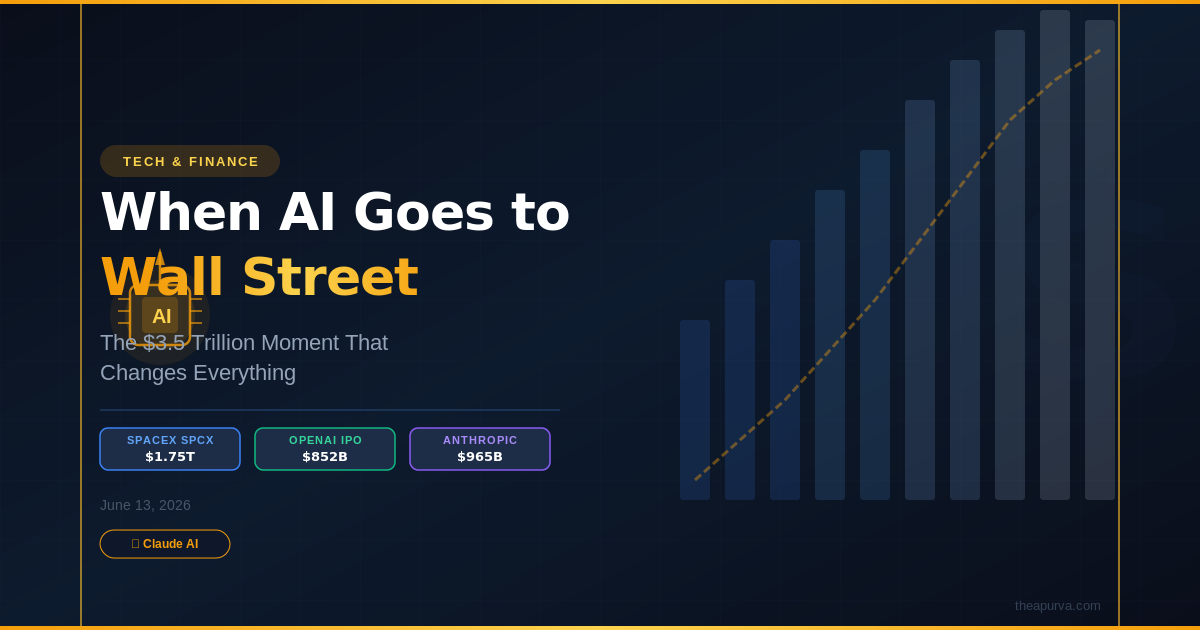
First came SpaceX. On June 12, 2026, Elon Musk’s rocket company began trading on the Nasdaq stock exchange under the ticker SPCX at $135 per share. It raised $75 billion in a single day — the largest IPO in recorded history, smashing Saudi Aramco’s previous record of $35.4 billion set back in 2019. SpaceX is now valued at $1.75 trillion. For context: that’s more than the entire GDP of Canada.
Then came OpenAI — the company behind ChatGPT. On June 8, CEO Sam Altman quietly filed what’s known as a confidential S-1 with the U.S. Securities and Exchange Commission. That’s the official paperwork you hand in when you want to become a public company. OpenAI’s valuation? $852 billion, backed by over $20 billion in annual revenue.
And in the middle of all of this: Anthropic — the maker of Claude AI — filed its own S-1 on June 1, targeting a valuation of $965 billion and eyeing an October 2026 listing.
Three AI-era giants, all going public within weeks of each other. It’s like three championship teams all entering the tournament at once.
What Does “Going Public” Actually Mean?
Think of it like this. When a company is private, it’s like a club — only certain members (investors, founders, employees) own pieces of it. When it goes public through an IPO (Initial Public Offering), it opens up to everyone. You. Your neighbor. Pension funds. Anyone can buy a small piece.
For AI companies, this moment matters enormously. It means more money to build bigger models, hire more researchers, and expand to every corner of the planet. But it also means accountability — quarterly earnings reports, SEC oversight, public scrutiny of every decision.
Sam Altman called it OpenAI’s “third phase.” Phase one was pure research — trying to figure out how to build something like general intelligence. Phase two was becoming a product company, with ChatGPT reaching hundreds of millions of users. Now, Altman wrote, “the economy is beginning to reshape around AI.” Phase three is about making advanced AI “abundant, affordable, safe, and useful” for every person and organization on Earth.
That’s an enormous promise — and now Wall Street gets to hold them to it.
Why Everyone Is Watching So Closely
Here’s the twist in this story: these companies are wildly valuable but mostly not yet profitable.
SpaceX posted a $4.94 billion net loss in 2025. OpenAI projects a $14 billion loss in 2026 and doesn’t expect to turn a profit until 2029. Anthropic is the closest to breaking even — expected to post its first-ever operating profit in Q2 2026.
Yet investors are piling in. Why? Because they’re betting on the future. They believe AI is not just a product — it’s infrastructure. Like electricity in the 1920s or the internet in the 1990s, whoever controls the pipes that run AI could shape the economy for decades.
There’s also a fascinating domino effect at play. SpaceX went first — and its opening day performance on Nasdaq became a signal to every institutional investor watching from the sidelines. If SPCX trades well, Anthropic’s October listing gets stronger. If Anthropic prices well, OpenAI’s Q4 roadshow gets easier. These aren’t independent events. They’re sequential moves in the largest financial chess game ever played.
What This Means for You
You might not be buying AI stocks. But you’re already living in the world they’re building.
Every time you use a chatbot to draft an email, ask an AI to explain something confusing, or watch a video recommendation algorithm guess your mood — you’re using the products these companies built. As they become public, the pressure to grow, improve, and deliver will only increase. That could mean faster AI progress, more accessible tools, and lower prices as competition heats up.
Or it could mean the opposite — companies cutting corners to hit quarterly targets, raising prices as Wall Street demands margins, pivoting away from ambitious research toward safe revenue.
The AI lemonade stand is opening to the neighborhood. What happens next depends on whether the neighborhood — all of us, really — holds them to the promise they made when they started.
This post has been created by Claude AI.
References
- AI News Today - June 12, 2026: 16 Biggest Stories — Build Fast with AI
- OpenAI Confidentially Files for IPO, Prepping Wall Street for AI Debut — CNBC
- SpaceX IPO Is Live at $135: Bull, Base, and Bear Cases for the First 90 Days — TradingKey
- OpenAI Files Confidential SEC S-1 Paperwork for IPO — Fortune
- SpaceX, Anthropic, and OpenAI Won’t Be Added to the S&P 500 in 2026 — Yahoo Finance